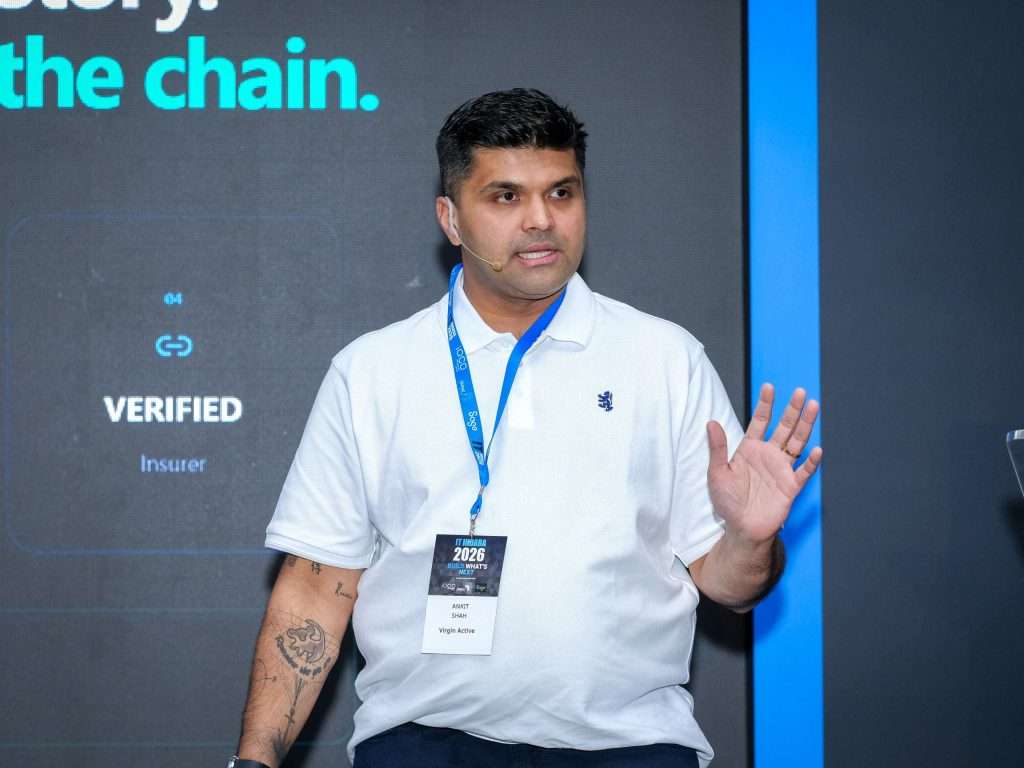
Ankit Shah, chief data officer at Virgin Active, urged technology leaders at the 2026 IT Indaba to look beyond generative AI to quantum computing, post-quantum cryptography and blockchain. He spoke during a session titled Beyond AI: Navigating quantum computing, blockchain and the next digital frontier.
Ankit’s message was that AI provides efficiency and bandwidth, but the next-generation technologies provide consequence, preservation, authorisation and, ultimately, digital trust. For technology leaders, this means preparing their data and security systems now for what quantum computing will change.
AI’s error rate needs accountability
AI has become a daily assistant that lifts productivity, but Ankit said its error margin means other technologies must hold it accountable.
“AI is one of the first technologies where the error rate is 20 percent and we still accept it. I’m not against it. I use it every day. But we have accepted a technology that is 80 percent accurate. So now there has to be something that will hold it responsible for the consequences that it is going to produce,” he said.
Intelligence alone cannot provide legal accountability or immutable proof, he argued. That is where frontier technologies come in, through simulation, cryptographic authorisation and digital preservation.
“AI creates intelligence. AI creates bandwidth, is how I would put it. At the same time, the new frontier technology that is emerging gives consequence. Quantum simulates selected problems, cryptography authorises it, and finally, blockchain preserves shared elements.”
Quantum computing is a new instrument, not a faster laptop
Ankit explained that quantum computing departs from traditional binary logic. Classical machines rely on switches of zeroes and ones, while quantum systems use superposition.
“When you have classical computers, they work with one and zero switches. Quantum computing works from superposition, and superposition could land anywhere between one and zero,” he said.
Quantum computers will not replace laptops or enterprise desktops. They are specialised instruments for complex scientific simulations in molecular chemistry, medicine and materials science. “It is not a replacement for a laptop. It is a very different instrument which will produce computational capability that does not exist in classical computers,” explained Ankit.
The quantum threat to cybersecurity and blockchain
Today’s standard cryptographic algorithms, including RSA and Elliptic Curve Cryptography (ECC), rely on mathematical problems that classical supercomputers would take decades or centuries to solve. Quantum computers can process multiple calculation stages at the same time, which means they could break these protections much faster and make traditional blockchain signatures vulnerable to forgery.
“Today’s cryptographic methods work on very simple things that would take 100 years to break. It will be different when quantum computers come because the computational power of those computers will be different. They will be able to get through multiple stages at the same time, so they will be able to break current cryptographic algorithms much faster,” Ankit warned.
He advised organisations to move to post-quantum cryptography standards authorised by NIST.
“There are post-quantum era cryptography algorithms available today that we could apply to start safeguarding our data systems and environments for a time when quantum computers become more available to the mainstream market. It is the same with AI. The adoption we’ve had in the last three years, I don’t think we’ve had in a decade.”
Blockchain must also adopt quantum-resistant algorithms if it is to remain an immutable, transparent open ledger.
Convergence and human care
Ankit said the future of enterprise technology lies in convergence rather than in isolated tools. In an integrated digital ecosystem, data acts as the sensor, AI provides decision intelligence, quantum solves previously unsolvable problems, robotics execute physical actions and blockchain authorises outcomes.
He urged African innovators and business leaders to build frontier solutions locally rather than rely on outdated frameworks.
“Instead of just inheriting something that was done yesterday in some other country or some other state, we should be building something which is supposed to come in the next two years. That is the thought I would like to provoke today. We should, in Africa, shape the digital future of this world.”
Ankit also reminded leaders that technology must serve human care.
“At the end of the day, technology supports us in knowing our members better, but making them feel welcome is the responsibility of the human. Try to invest in tech that comes in the future, not the tech that is present, because the tech that is present today is yesterday’s tomorrow.”